
Faux wood ceiling beams offer the warm look of solid wood without the cost, weight, or complex installation. In this guide, we explain how to install faux wood beams on a ceiling in nine simple steps, along with tips for planning your layout and handling special installation scenarios like cathedral ceilings, ductwork, and lighting.
Table of Contents
- Before You Get Started: Installation Materials and Prep
- How to Install Faux Wood Beams (Video Tutorial)
- How to Install Faux Wood Beams Step-by-Step
- Special Faux Wood Beam Installation Scenarios
- Frequently Asked Questions
- How to Choose the Right Faux Wood Beam
Nothing makes a bigger statement in a room than beautiful ceiling beams. The natural texture, wood grain, and warmth of wood beams instantly add character and architectural interest to a space.
Solid wood beams, however, can be expensive to purchase and difficult to install. Because they are heavy and often require professional installation, the labor costs alone can add significantly to your project budget.
Faux wood ceiling beams offer a much easier alternative. Designed to replicate the look and texture of solid wood, faux beams are lightweight, customizable, and far easier to work with. In many cases, installing faux beams is a DIY-friendly project that can be completed in just a few hours.
Below, we’ll walk you through how to install faux wood ceiling beams, including the tools you’ll need and helpful tips for a smooth installation.
Before You Get Started: Installation Materials and Prep
Before installing faux beams on your ceiling, make sure the surface is structurally sound and in good condition. The drywall should be flat and smooth to minimize visible gaps between the beam and ceiling. If repairs are needed, complete them before beginning the installation process.
Next, gather the following tools and materials:
- Caulk Gun
- Chalk Line/Laser
- Clean Cloth
- Color Complementing Textured Caulk
- Deck Screws
- Hand Saw with Finish Blade
- Ladder x 2
- Painters Tape
- Pencil
- Loctite PL Premium 3X Construction Adhesive
- Safety Glasses
- Screw Gun/Drill Driver and Bits
- Small Paint Brush
- Square/T-Bevel
- Stud Finder
- Tack Cloth
- Tape Measure
- Toggle/Lag Bolts
- Touchup Kit
- Wood Beams
- Wood Blocking (2x4” or 2x6”)
- Wood Cutting Saw with Finish Blade
How to Install Faux Wood Beams (Video Tutorial)
If you prefer a visual walkthrough, watch our step-by-step installation video below. The process shown in the video follows the same steps outlined in this guide, making it easy to follow along as you install your beams.
How to Install Faux Wood Beams Step-by-Step
Below is an overview of how to install faux wood beams on a ceiling. When you’re ready to get started, follow these steps or reference our detailed installation instructions with diagrams.
Step 1. Lay Out the Installation
This is where you map out your beam design, determine how far apart to space your beams, and in which direction you want them to run. Once you have your beam design mapped out, mark your guidelines using a laser or a chalk line.
Step 2. Locate Studs and Mark Them
Using a stud finder, locate the studs and mark them with a pencil. If the studs don’t line up with the installation, you’ll need to use toggle/lag bolts to attach your mounting blocks. Mark all studs using a stud finder and pencil.
Step 3. Determine How Many Mounting Blocks You Need
To calculate how many mounting blocks you need, use the formula A+B+C.
- 1 block at each end of the beam (2 blocks)
- 1 block at least every 3 feet of the beam
- 1 block used at the joint where beams meet if you’re using more than one beam in a run
Step 4. Measure and Cut Your Mounting Blocks
Grab your ceiling beam and measure the inside dimensions, then subtract ⅛ inch to determine the size of the mounting blocks.
Then, cut the quantity of mounting blocks you calculated in step 3 and pre-drill at least two holes per block to make them easier to attach.
Step 5. Attach Mounting Blocks to the Ceiling
Attach the first mounting block as close to the side wall as possible and in line with the guides you drew in step 1.
Then, secure additional mounting blocks to the ceiling at 3-foot intervals using screws into studs or toggle/lag bolts into drywall. Be sure to place a block where the beams meet if you’re using more than one beam in a run.
Mark the location of the mounting blocks by placing painter's tape about 1½ inches from each side of the blocks. This will be helpful for step 8.
Step 6. Dry Fit
Check your beam length by dry-fitting it in place. Your beam should fit snug, but shouldn’t need to be forced into place. Trim if needed.
Step 7. Apply Adhesive
Wipe the edges of the mounting blocks and the inside of the beam to remove dust and debris.
Then apply adhesive to the edges of the mounting blocks that will contact the beam.
Step 8. Install Beam
Slide your beam in place over the mounting blocks.
Slightly countersink a minimum of two screws per side, through the beam at each mounting block. This holds the beam in place until the adhesive dries.
Wipe off any visible adhesive using a clean cloth.
Step 9. Touch Up
Apply color-complementing textured caulk to fill screw holes, then blend caulk into adjacent surfaces while it is still wet.
If necessary, apply caulk to joints and gaps. Use paint from your touch-up kit to paint over the caulk.
And, that’s it! In just nine simple steps, with the help of one other set of hands, you can install faux wood beams in just a few hours.
Special Faux Wood Beam Installation Scenarios
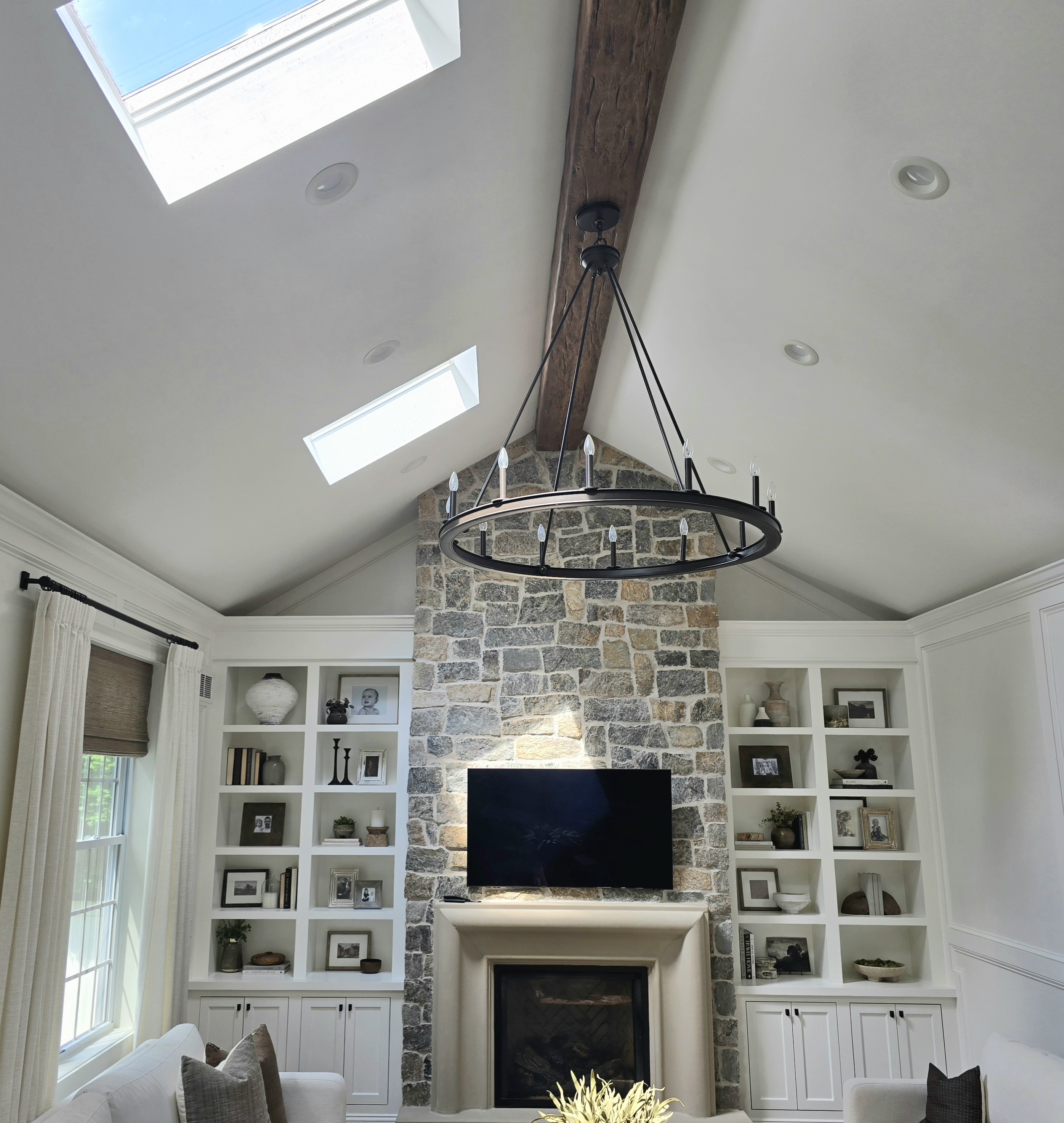 Magnolia Faux Wood Beams in Cappuccino
Faux wood ceiling beams are hollow, giving them an advantage over solid wood beams in many situations. Their hollow design allows them to conceal structural elements such as ductwork, pipes, and steel supports while maintaining the appearance of solid wood.
If your installation involves lighting, ductwork, or other structural features, keep the following scenarios in mind before installing your beams.
Installing Recessed Lighting in Faux Beams
You don’t have to sacrifice lighting to enjoy the visual impact of ceiling beams. Faux beams can accommodate recessed lighting installations with proper planning. If this is part of your project, follow our recessed lighting installation guide.
Using Faux Beams to Cover Ductwork
The hollow design of faux wood beams makes them ideal for hiding ductwork, pipes, or structural elements that would otherwise remain visible. If you plan to conceal ductwork, follow our instructions for installing ducts and vents in faux beams.
Hanging a Ceiling Fan or Chandelier from a Beam
If you plan to hang a ceiling fan or chandelier from a beam, you’ll need to follow additional mounting steps to ensure proper support. Be sure to review the ceiling fan and chandelier installation guide before installing your beam.
Installing Faux Beams on Cathedral Ceilings
Installing beams on a cathedral ceiling requires locating the highest point of the ceiling, also known as the apex. Mounting blocks must be secured with screws long enough to reach the ceiling studs. For additional guidance, review our ridge beam installation instructions.
Installing Faux Beams Under 10 Feet Long
Shorter beam runs are typically easier to install because they require fewer mounting blocks and are easier to maneuver during installation. In most cases, beams under 10 feet long follow the same installation process outlined above.
Frequently Asked Questions
Now that you understand the installation process, here are answers to some of the most common questions homeowners ask about installing faux wood beams.
Are faux beams easy to install?
Yes. Faux wood beams are designed to be lightweight and DIY-friendly, making installation far easier than installing solid wood beams. With basic tools, mounting blocks, and the help of a second person, most homeowners can install faux beams on a ceiling in just a few hours.
How far apart should I put faux beams?
Beam spacing plays a major role in the overall appearance of a room. Beams installed closer together create a cozier feel, while wider spacing can make ceilings appear taller and more open.
In most homes, faux beams are spaced between 2 and 8 feet apart, with about 4 feet being the most common spacing. Room size, beam width, and ceiling height can all influence the ideal layout.
If you’re unsure what spacing will look best in your space, see how far apart to space faux wood beams, where you can use an interactive visualizer to preview different spacing layouts.
Which way should faux ceiling beams run?
Beam direction is largely a design choice, but many homeowners install beams across the shortest span of the room to create a more natural and structural appearance.
On cathedral or vaulted ceilings, beams may run in either direction depending on the overall design and architectural layout.
Do faux beams add value to a home?
Faux wood beams can increase the visual appeal of a home by adding architectural detail and dimension to a space. While they may not raise property value as directly as structural upgrades, they often make interiors feel more custom and attractive to potential buyers.
How to Choose the Right Faux Wood Beam
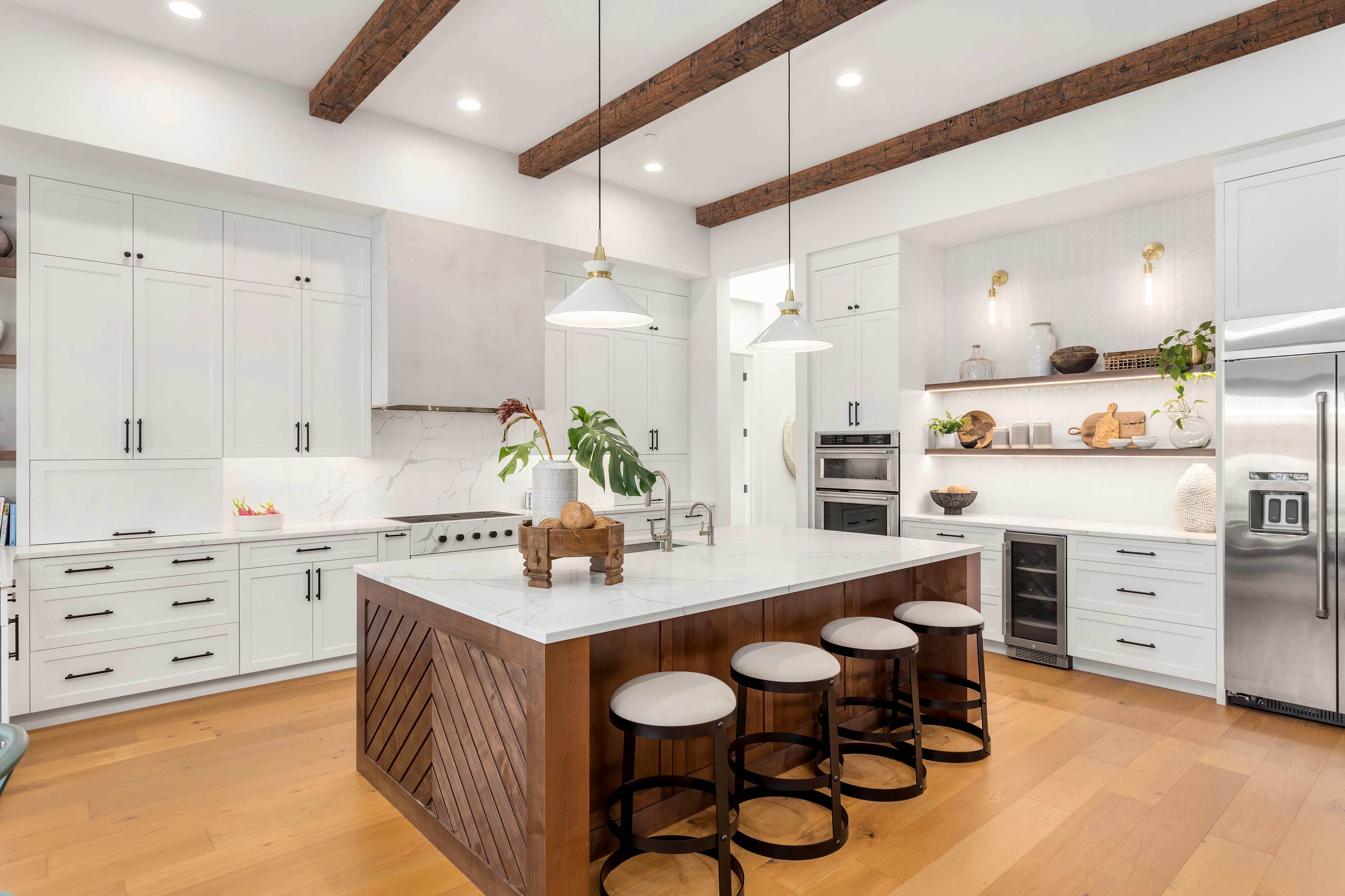 Old Tuscan Faux Wood Beams in Burnished
Faux wood beams offer many advantages over solid wood beams, including lower cost, lighter weight, and easier installation. Best of all, modern faux beams are designed to closely replicate the look and texture of solid wood beams.
AZ Faux offers a wide range of faux wood beam styles, including classic beams, arched beams, and custom truss designs. No matter which style you choose, you’ll get a beam that delivers the beauty of solid wood without the maintenance.
With installation this simple, you can transform the look of a room in just a few hours.
Ready to add character and warmth to your space?